Free · Türkiye
The Destination Is Not Enough: Check the Ferry Pier
A practical Istanbul ferry guide for someone who wants to enjoy the crossing—and arrive at the right place.
You are standing near the water in Istanbul. A ferry is approaching. The board in front of you names a district you recognise. The next trip should be simple, shouldn't it?
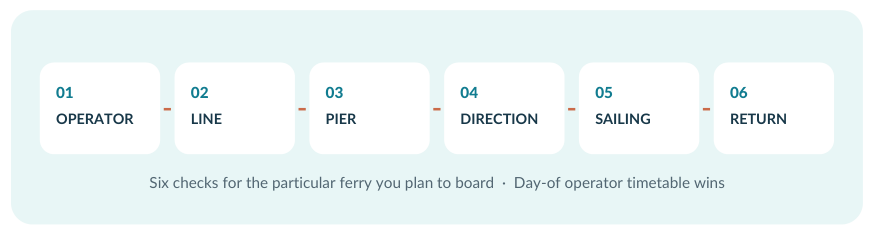
Sometimes it is. But an Istanbul ferry trip has five separate answers: which operator, which line, which departure pier, which direction, and which departure on the day you are travelling. If you are making a return trip, there is a sixth answer: where and when can you get back?
The distinction matters because one familiar place name can appear on several routes. Kadıköy, for example, is served by routes toward different European-side destinations, and the official operator's own timetables distinguish Kadıköy (Old) Pier and Kadıköy (New) Pier for some late-night departures. The Şehir Hatları pier directory and individual line pages—not a city-name match on a map—are the starting point. [1–4]
This article uses Istanbul's municipal passenger-ferry operator, Şehir Hatları, as its worked example. Other ferries, sea buses, and private operators have their own lines, payment arrangements and terminals. A route displayed by one company is not automatically an interchangeable ticket or boarding point for another.
The six questions to answer before walking to the gangway
1. Who operates this boat? Read the operator's name on the timetable or at the terminal. For the examples below, open Şehir Hatları's official Domestic Trips directory [1]. If your search result or ticket names a different operator, use that operator's own live route and boarding instructions instead.
2. What exact line am I taking? “Kadıköy to the European side” is not a line name. The Şehir Hatları directory currently lists separate lines including Kadıköy–Karaköy–Eminönü, Kadıköy–Beşiktaş, and Kadıköy–Kabataş. It also lists longer or multi-stop services. Select the line containing your intended destination instead of assuming all ferries leaving Kadıköy are going to the same waterfront. [1–3]
3. Which departure pier and entrance? A ferry pier is an actual boarding place, not just a neighbourhood. The operator maintains a Piers directory, and the Kadıköy entry shows distinct pier facilities. A timetable can specify Kadıköy (Old) or Kadıköy (New). Read the pier note for the particular departure you plan to use, then locate its operator and boarding sign on the ground. [3–5]
4. In which direction? A timetable may show two separate directions on one page. Make sure your current pier is in the departure column and your destination appears in the sequence ahead, not behind. On a multi-stop line, read the stop order, not merely the line title.
5. Which service runs on my date? Do not copy a departure from a screenshot without its footnotes. On the official line pages, asterisks sometimes distinguish weekdays, weekends and public holidays; other notes identify trips that skip a pier. The fine print is part of the timetable. As of the 22 October 2026 source check, the Kadıköy–Karaköy–Eminönü line page includes an annotated sailing that does not board at Karaköy. [2] That example explains why seeing the pier's name in a line title is not enough to guarantee you can board every sailing there.
6. How do I return? Before travelling outward, locate the official reverse-direction timetable and the pier you would actually use for the return. Set a realistic time to finish dinner, a museum visit, or a walk; leave room to reach that specific terminal. On the day, recheck changes and cancellations. Your route back may not be the exact reverse of the outward service at the time you want it.
If you answer these six questions, you have a usable trip rather than a hopeful guess.
A five-minute demonstration: from Kadıköy toward Eminönü
This is a reading exercise, not a timed itinerary or a promise that a particular departure will operate later.
Situation. You are staying near Kadıköy and want to reach Eminönü for a walk on the historic peninsula. Someone has said, “Just get on the ferry.”
Start at the official Domestic Trips directory [1]. Look for the line specifically titled Kadıköy–Karaköy–Eminönü [2], rather than clicking the first line with “Kadıköy” in it. Check whether Eminönü appears on the relevant direction's stop list, and whether the sailing stops at any intermediate pier you care about. The official page includes separate directional tables and departure notes. [2]
Next open the Piers directory [4] and inspect the Kadıköy pier page [5]. If the sailing has a special boarding-pier note, resolve that note before leaving your hotel. Save the exact terminal identity, not only the word “Kadıköy.”
Now imagine two statements:
- Incomplete: “We leave Kadıköy around lunchtime.”
- Useful: “We will take the Şehir Hatları Kadıköy–Karaköy–Eminönü service, from the departure pier listed for our chosen sailing, in the direction that calls at Eminönü. We have checked the operator's timetable and its date-specific notes today.”
The second version contains enough detail to check. It does not require you to memorise the entire city network.
After you arrive, walk only after checking where that arrival pier actually sits relative to your next destination. Eminönü is a district; your hotel, market or meeting point may still require a walk or a connecting journey. The pier is the end of the ferry leg, not necessarily the end of the trip.
On the return: If you plan to return to Kadıköy, choose the reverse direction on the same official route page and inspect the conditions on the specific evening sailing. If the ferry is not suitable, use an independently checked alternative rather than guessing that one of the other boats at the waterfront must be yours.
Another example: the same Kadıköy name, a different destination
You would like to meet friends in Beşiktaş. Your last experience was the Eminönü crossing, and a familiar terminal is in front of you.
Stop. Beşiktaş is not Eminönü. The operator has a separate Kadıköy–Beşiktaş line [3], with its own departure tables and pier information; there is also a late-night Kadıköy–Karaköy–Beşiktaş service on specified weekend nights with old-versus-new Kadıköy pier notes. [6] The same neighbourhood can therefore appear in several genuinely different services.
Do not assume a boat bound for Karaköy will take you directly to Beşiktaş, or that the Beşiktaş boat boards at precisely the spot you used on your last crossing. Check your chosen line, stop order and departure pier separately. This is why recognising the sign “Kadıköy” is a start, not the end of your decision.
What the place names tell you—and what they do not
| Sign or label | What it identifies | Still to check |
|---|---|---|
| Kadıköy | A district/possible ferry departure area | Which actual pier, operator, line and direction? |
| Karaköy | A waterfront destination or intermediate stop on some lines | Is this sailing stopping and boarding there? |
| Eminönü | A district and pier destination | Which arrival terminal and onward route? |
| Beşiktaş | A district served by multiple lines | Which operator and which exact departure pier? |
| Kadıköy (Eski) | “Kadıköy (Old)” pier as specified by a route note | Does your sailing specifically depart there? |
| Kadıköy (Yeni) | “Kadıköy (New)” pier as specified by a route note | Does your sailing specifically depart there? |
These are orientation cues, not universal route promises. The operator's page and actual terminal signs settle the question for your date. [3–6]
A trap that looks like a bargain: the ferry is close, but the connection is not
Consider this fictional afternoon:
You want a short waterfront outing. A map shows a pier only a few minutes from your lunch stop. Across the water, your next destination seems close to another pier. The trip looks easy—until you discover the line you chose does not go to that pier, or the useful return service operates at a different time.
A better approach is to calculate the whole trip, not just the water crossing:
Where I am → departure pier → correct boat/direction → arrival pier → actual destination → return pier → last useful connection → where I am staying.
A ten- or twenty-minute crossing can still be a poor choice if getting to the departure terminal or returning at night is awkward. Conversely, a ferry that is not the geographically shortest crossing can be the more enjoyable, less confusing option when the piers fit your actual plans.
Do not let an attractive map replace a day-of-travel check. A reader should be able to identify the route from the official line title and stop sequence, then assess how much time remains for coffee, a museum or the walk home.
Reading a Turkish timetable without pretending to know Turkish
You do not need a full Turkish course for this journey. Knowing a handful of common signposts helps you recognise what to verify, even if you use the operator's English site:
- iskele — a pier or landing. The form iskelesi includes a possessive ending and appears in names such as Kadıköy İskelesi (literally, “Kadıköy’s pier”). Read the whole name to identify the intended pier.
- kalkış — departure; look for the departure stop and time.
- varış — arrival; not an invitation to board there.
- sefer — a service or scheduled trip; sefer iptal signals a cancelled service in relevant notices.
- hafta içi — weekday; hafta sonu — weekend; resmî tatil — public holiday.
- aktarma — transfer; check whether this is a deliberate part of your route.
- eski / yeni — old / new, as in a pier note; neither tells you which is correct without your specific sailing.
These are reading aids, not substitutes for live signs, instructions and the correct operator page. Turkish characters matter: Kadıköy, Üsküdar, Eminönü, Beşiktaş, Karaköy should be copied carefully into a search or map rather than typed as whichever English-like spelling seems familiar. For a real request, show the complete Turkish place and operator name to a member of staff if needed.
Paying and boarding: verify the operator rather than importing a rule
Istanbul transport is often presented as a single unified journey, but payment products, accepted cards, discounts, visitor registration and special sailings can differ between operators and evolve over time. This article does not promise that one card can pay for every possible ferry, that a tourist receives a resident discount, or that a discounted pass can be shared. Use the operator's current tariffs and passenger information before boarding, particularly for a private operator or unusual route. [1, 7]
At the pier, look for the correct operator, route, direction and boarding gate before making a payment. If your card or method fails, ask the local operator about the currently supported alternatives; do not assume a ticket bought elsewhere will work automatically. Keep a way to check onward transport even if mobile data fails. A screenshot of your operator, route, pier and accommodation address can be more useful than a screenshot of an unverified fare.
If something changes while you are there
The pier sign does not match your plan. Step away from the queue, reopen the named operator's line page, and compare the current departure pier and direction. Do not board first and reason about it later.
The timetable includes asterisks or a footnote. Read the full note, including the day category. If you cannot establish whether a specific sailing boards at your pier, ask staff before passing the gate. [2–3]
Your ferry is cancelled or weather affects the service. Check the operator's current notices and the service display. Decide whether waiting or changing your plan is sensible; do not announce a made-up replacement boat. Transport conditions are dynamic, and a general article is not a live operations feed.
You missed the return ferry. Find the latest usable alternative through a live official operator or transit source. The fallback may involve travelling to a different departure point, a different mode, or postponing the outing. Share the actual new route with anyone expecting you rather than relying on an assumed last boat.
You need step-free access or have limited mobility. Şehir Hatları publishes a general accessibility policy that discusses ramps, signs and onboard assistance. [8] This is not confirmation that a particular pier, vessel, walkway or connection will meet your needs on your sailing. Contact the operator and check the entire pier-to-pier-plus-onward route rather than treating the word “ferry” as an accessibility guarantee.
You are travelling with children or bulky luggage. Choose a plan with enough time to locate the pier, use the correct entrance, and manage the onward journey without rushing. Family comfort is an itinerary question as much as a timetable question.
Your before-you-leave card
You can save this small card on your phone. Complete it from the operator's current official information; do not fill it from memory.
| Question | My confirmed answer |
|---|---|
| Operator | __________________________ |
| Exact line | __________________________ |
| Departure pier/entrance | __________________________ |
| Direction and intended stop | __________________________ |
| Date and sailing; footnotes checked | __________________________ |
| Payment method accepted for my trip | __________________________ |
| Arrival pier → onward destination | __________________________ |
| Return pier and useful last connection | __________________________ |
| Alternative if the service changes | __________________________ |
One last habit
Before you join a ferry queue, ask yourself: “Is this the right pier for this particular sailing, in this direction, on this day—and have I checked the way back?”
That extra minute is not a nuisance. It is often the difference between worrying about a boat and actually enjoying Istanbul from the water.
Official sources and check date
The source list was checked 22 October 2026; the key Kadıköy route and pier pages were rechecked 23 October 2026. Timetables, pier assignments, payment rules and live notices can change. The links provide the latest operator information, not a guarantee for a future date.
- Şehir Hatları, Domestic Trips / line directory: https://sehirhatlari.istanbul/en/timetables/domestic-trips/ — identifies distinct inner-city, Bosphorus and island passenger lines.
- Şehir Hatları, Kadıköy–Karaköy–Eminönü route: https://sehirhatlari.istanbul/en/timetables/domestic-trips/inner-istanbul-ferry-lines/kadikoy-karakoy-eminonu-163/ — directional tables and sailing footnotes, including a no-boarding annotation at Karaköy for one listed departure.
- Şehir Hatları, Kadıköy–Beşiktaş route: https://sehirhatlari.istanbul/en/timetables/domestic-trips/inner-istanbul-ferry-lines/kadikoy-besiktas-165 — separate route and pier directions.
- Şehir Hatları, Piers directory: https://sehirhatlari.istanbul/en/piers — current list of pier information.
- Şehir Hatları, Kadıköy Pier: https://sehirhatlari.istanbul/en/piers/kadikoy-38 — more than one identified Kadıköy pier facility.
- Şehir Hatları, Kadıköy–Karaköy–Beşiktaş route: https://sehirhatlari.istanbul/en/timetables/domestic-trips/inner-istanbul-ferry-lines/kadikoy-karakoy-besiktas-768 — night sailings with old/new Kadıköy pier notes.
- Şehir Hatları official site, live route and passenger service directory: https://sehirhatlari.istanbul/en — current operator-level information should be checked for fare and ticket conditions.
- Şehir Hatları, Accessibility and Şehir Hatları: https://sehirhatlari.istanbul/en/information/accessibility-and-sehir-hatlari-251 — operator's general accessibility commitments, not individual-sailing certification.
Location references
These Google Maps searches identify the places discussed here. Confirm the exact address and current access separately.